A great variety of animals and plants survive in and around rock pools. Some need to stay immersed in seawater all the time. Others are able to tolerate a degree of drying out when the tide goes out.
The animals which may be found can be divided into several groups. Details on individual animals in each group can be seen by clicking the link
Mussels, limpets, periwinkles etc:
Animals:
Vertebrata: Fish.
Vertebrates include mammals, reptiles, amphibians but only fish will be found in the rock pools.
Blennies and Gobies
If you catch or see a fish in a rock pool on Milsey Bay it will probably be either a Goby or a Blenny but it can be hard to tell them apart. One of the easiest ways to identify them is to look at their dorsal fins – if there are two – that’s a Goby, but one long one is a Blenny. Another way to tell the difference is when lying on the bottom of a rock pool, a Goby will have a straight body, whereas a Blenny is curved.
Blenny
Several species of Blennies are found in Scotland, including the common Blenny (sometimes called Shanny), the tompot blenny, and the butterfly blenny. They are all similar in appearance so probably best not to try to identify individuals unless you are an enthusiast.

Elongated body with a large, blunt head and big eyes. Variable in color, often brown or beige with darker blotches. Males are almost black during the breeding season.
Found in rock pools and shallow waters, often hiding under stones or seaweed.
Eats a variety of food, including seaweed, barnacles, and small invertebrates
Goby
There are 16 species of Goby in the UK.
Common Goby: Pomatoschistus microps

Common Gobies are small fish with a sandy grey colouration and darker patches blotching their back and sides. Their eyes are large and sit high up on their heads. This is the one you are most likely to catch or see.
The Common Goby is a small goby growing up to 6 cm in length. The top of the head, nape and throat are scaleless. It is grey or sandy in colour, often with darker blotches across the back and faint marks along the side of the body. There is also a dark area at the base of the pectoral fins and tail fin.
Worm Pipefish: Nerophis lumbriciformis

The Worm Pipefish (Nerophis lumbriciformis) is the most common pipefish found on UK shores. They are long, slender fish that looks like a worm or a piece of seaweed. They can get to 15cm in length, have a small dorsal fin behind the head and are dark green in colour. If you look closely at their head, you’ll notice a small snout similar to a seahorse.
Butterfish: Pholis gunnellus
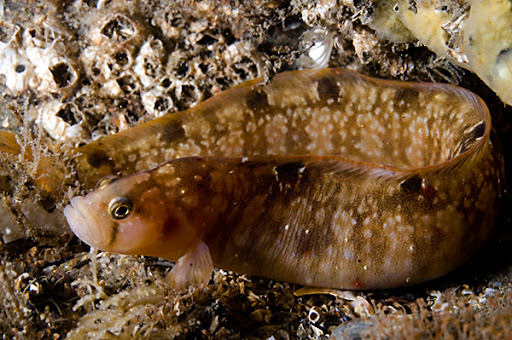
The butterfish is a small eel-like fish found in rockpools and shallow seas all around the UK. They are pretty shy and are normally hidden in crevices or under rocks and seaweed. You might also hear of butterfish being called Gunnels or Rock Gunnels. They feed on anything they can find, including small crustaceans, molluscs and fish eggs. Butterfish lay their eggs on rocky shores, hiding them away from predators in crevices. Unlike in most fish species, both the Mum and the Dad take it in turn to guard their unhatched eggs from hungry predators.
Long Spined Sea Scorpion:Taurulus bubalis

Long spined sea scorpion has a large, bulbous head with a distinctive small barbel in each corner of the mouth. The body tapers down towards the tail, with large pectoral fins which sit behind the head. Colouration is usually mottled with pink, red and sandy blotches. This this species can adapt and blend in perfectly with the surrounding algae and encrusting organisms. Grows up to 20cm.
This colourful fish gets its name from the long spines attached to various parts of its body. This fish has amazing mottled colouration and can change its colouration to blend in perfectly with its background. A top predator it gulps up crabs and fish with its huge mouth.
A guide to identify the fish commonly found in UK rock pools can be found on the link below
Crustacea: Crabs, Prawns, Shrimp etc
Shore Crab: Carcinus maenas

The shore crab is the most common crab encountered on our shores. Normally a green-ish colour, shore crabs are easily found in rockpools or on the end of crab lines dangled into shallow waters.
Also known as the Green Shore Crab.
Edible Crab: Cancer pagurus
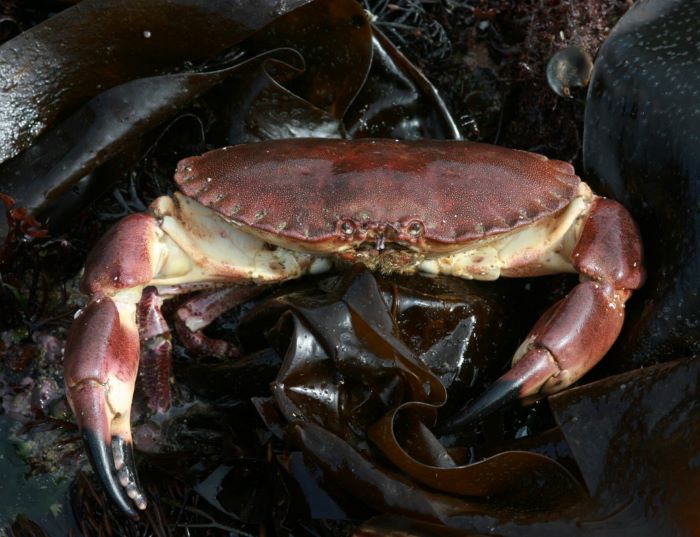
The edible crab is a large crab, brown in colour apart from black tips on the end of its claws. It is sometimes known as the brown crab. They have a thick, oval shaped shell (carapace) with a distinctive pie crust edge. Small juvenile individuals may be found in the rock pools.
They live on the lower shore and out under the sea to about 100m depth. On rocky shores, they are normally hidden away under boulders. It is an active predator and will feast on mussels, whelks and even smaller crabs. They are also known to dig for prey such as razor clams and otter shells.
Velvet Swimming Crab: Necora puber

Their body is covered in short hairs that give a velvet appearance and are soft to the touch, just like velvet. Like all swimming crabs, their rear-most legs are flattened like paddles, helping them swim effectively. They are speedy underwater and will catch swimming prey like fish and prawns, as well as munching on easier catches like worms, clams and sea snails.
If you spot a crab with a big orange mass on their underside, don’t worry – those are their eggs! Females carry the fertilised eggs around with them, protecting the eggs from hungry predators. An egg-carrying female is referred to as “berried”.
Spider Crab: Hyas araneus
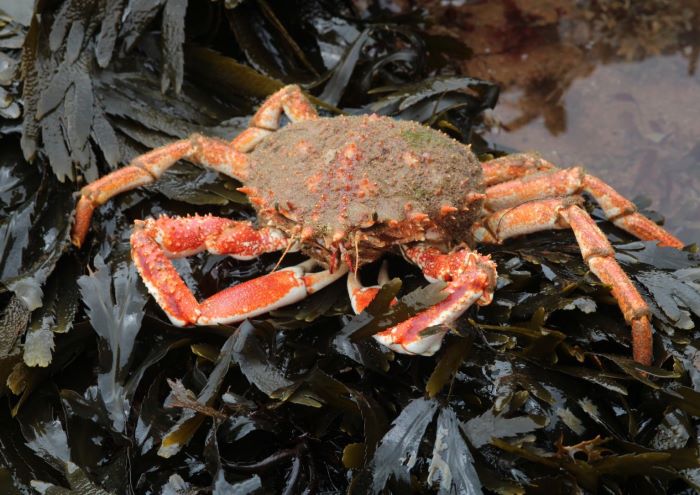
A pear-shaped crab with a pointed face, the great spider crab has long, spindly legs like a spider. Also known as the sea toad, it lives amongst rocks and seaweed from the low tide mark and out to around 50m deep. It is a Northern species, with the UK sitting at the southernmost limit of its range. It is known to be partial to munching on jellyfish.
Spider crabs are very different to ‘typical’ crabs. Orangey brown in colour, the great spider crab has long spindly legs like a spider and a distinctive pear-shaped shell. It is smaller than the spiny spider crab, which has an oval and more visibly spiky shell.
Hermit Crab: Pagurus bernhardus
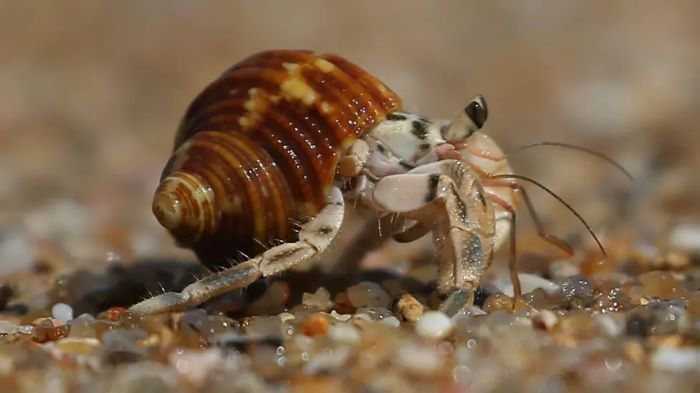
The hermit crab will crawl around with the shell on its back and will only leave when it grows too big, and has to find a new, larger shell, such as that of the common whelk. In most cases, they will use the shells of dead snails, but squabbles for possession of an already occupied shell frequently occur. In addition to finding a new ‘home’, hermit crabs also moult. When ready to moult, the new skeleton grows under the old one. The old exo-skeleton splits and comes off; the new skeleton takes some time to harden.
One of the most fascinating aspects of hermit crab behaviour is their association with other animals. Acorn barnacles, or algae can be found growing on their shells and they can enjoy symbiotic (mutually beneficial) relationships with sea anemones. The anemones’ stinging tentacles help to deter predators and provide amazing camouflage. In return, the sea anemone gets scraps from the Hermit Crab’s meals and is transported to food sources. Some hermit crabs even transfer their anemones when they ‘move’ from a smaller shell into a larger shell. Like all British crab species the hermit crab is a scavenger and will look for dead and dying forms of marine life to feed on.
Squat Lobster: Galathea squamifera
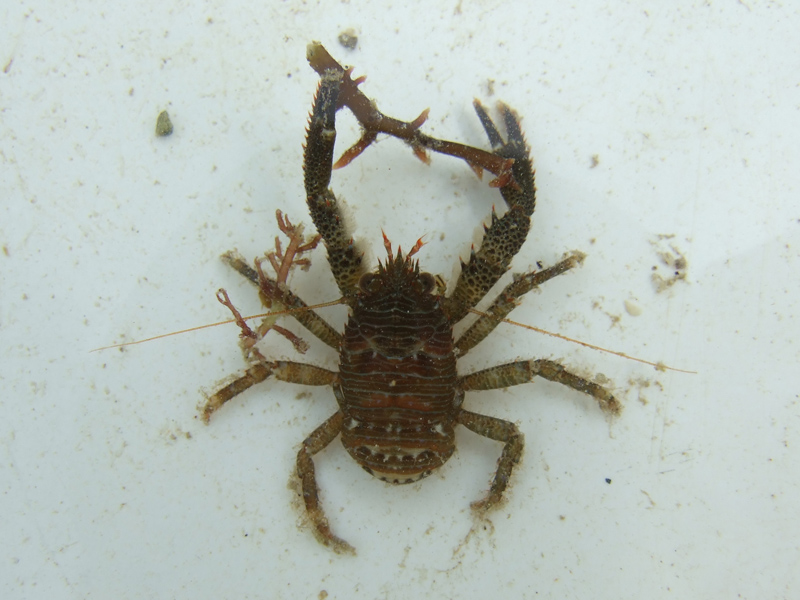
Despite their name, squat lobsters are actually small crabs belonging to the Galatheidae family. They are more closely related to porcelain and hermit crabs than true lobsters.
Common Prawn: Palaemon serratus and Rockpool Shrimp: Palaemon elegans

Common prawns are found in rockpools and shallow waters down to around 40m deep, normally hiding in crevices or under stones. It is virtually identical to the Rockpool Shrimp (Palaemon elegans); they can be told apart by the number of teeth on the rostrum.Common prawns are scavengers and will eat anything they find, from decaying seaweed to dead mussels.
Both have a translucent body with brownish-red tiger stripes along the length. It has large eyes separated by a serrated rostrum. Its walking legs are banded with reddish-brown and bright yellow and it has very long brown antennae.
Mollusca: Mussels, limpets, periwinkles etc.
Over 100,000 different molluscs have been identified. Several are common in Milsey Bay rock pools.
Echinoderma: Starfish, Sea urchins etc:
The Phylum Echinodermata is a diverse group of marine invertebrates, characterized by spiny skin, radial symmetry, and a unique water-vascular system.

Common starfish:Asterias rubens
The common starfish is highly common in UK seas, found in rockpools and out at sea to depths of at least 600m. They are active predators, feasting on bivalves such as mussels and clams. As such, they have been known to become a bit of a pest on mussel and oyster beds! Starfish feed on shellfish by pulling the shells open with their arms, inserting their own stomach into the shell and dissolving their prey with digestive juices, before reabsorbing their stomach full of the shellfish soup.
Starfish will form huge aggregations when food is plentiful, drawn in by their keen sense of smell. They don’t have a nose – they use special receptors in their skin!. Starfish aren’t really fish, they are a type of sea creature called an echinoderm, which means “spiny skinned”. Echinoderms includes starfish, sea urchins, sea cucumbers and brittlestars.

Common brittlestar: Ophiothrix fragilis
The common brittle star is extremely variable in colouration, ranging from violet, purple or red to yellowish or pale grey, often spotted with red. The arms are usually white or grey with pink bands. The central disc is about one centimetre in diameter with the five arms being about five times as long. The disc is clothed in five rays of spines radiating from a spiny centre. Between these are five pairs of triangular plates, each pair forming a heart shaped pattern. The slender tapering arms are quite distinct from the disc and are covered with overlapping scales.The dorsal arm plates are naked and have a longitudinal keel. Each arm segment bears seven glassy, toothed spines. The arms are extremely fragile and easily shed, coming away either whole or in pieces.
Actiniaria: Sea anemones
Plants
Virtually all plants found in the rock pools will be species of seaweed. The shoreline has its own plantlife, mostly grasses
Seaweed