Molluscs are invertebrates, which means they are animals that do not have a backbone. They come in all shapes and sizes, and some of them grow external shells to protect their soft bodies. There are over 85,000 species worldwide. Molluscs are the second largest grouping of animals on the planet, second only to Arthropods (insects, crabs, spiders etc). Molluscs include clams, snails, slugs, octopuses, squids, nudibranchs and oysters.
Only a few of the 85,000 species are likely to be seen on Milsey Bay and are shown in no particular order.
Periwinkles:
There are at least eight species that can be found on UK rocky shores. The common or edible periwinkle is the most likely to be seen and in large numbers.
Common periwinkle: Littorina littorea

The edible periwinkle has a rounded, whorled shell, usually greyish-brown in colour. It has concentric ridges, dark lines and a pointed apex. It is distinguished from similar, snail-like periwinkles and topshells by the slightly larger size, rounded shape and generally plainer colours.
This large sea snail is found on rocks and amongst seaweeds around the middle to lower parts of the shore. Known as the edible periwinkle, common periwinkle or winkle, it looks pretty similar to a land snail, with a dark brown or grey banded shell and little eye stalks poking out. The edible periwinkle feeds by grazing on algae on the rocks using its rasping tongue, called a radula. They don’t like dry areas, so will often be spotted clumped together in a crevice or rockpool at low tide.
Limpets:
There are three species of Limpet found around UK shores. Only one is likely to be found at Milsey Bay
Common limpet: Patella vulgata
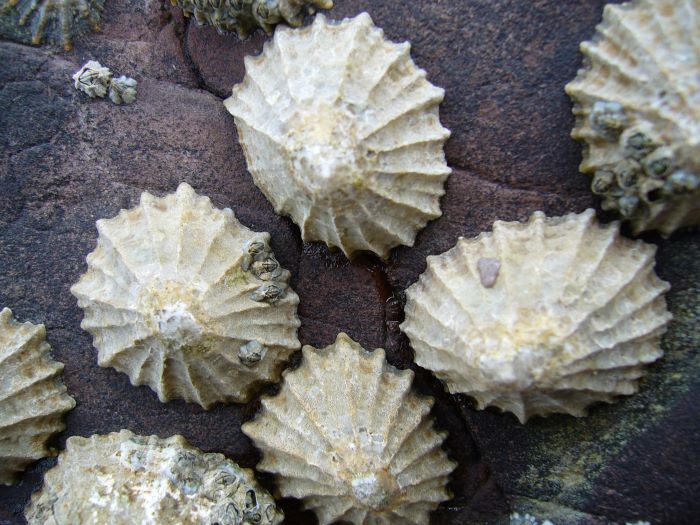
Common limpets are the small cone-like shells that are often seen firmly clamped to the side of rocks in rockpools. Although they may not look impressive at first glance, once the tide comes in they spring to action, moving around rocks eating algae using their tough tongue. Their tongue is the world’s strongest known biological structure – it needs to constantly scrape algae off of tough rocks!
REMEMBER: Do not attempt to remove a limpet stuck onto a rock, you may damage the muscles used to keep them there!
Topshells:
Topshells, a type of marine snail, are characterized by their conical or flattish shells, often with distinctive bands or patterns. They are also known for their ability to breathe underwater and are important grazers, feeding on algae and other organic matter. There are many species with a similar form with various differences in shape and colouration.
Purple topshell: Steromphala umbilicalis
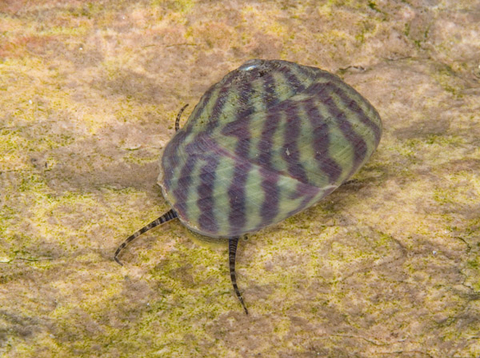
The purple topshell is the most common to be found on Milsey Bay.
These small, highly attractive sea snails are very common across most seashores and shallow waters, spending most of their time grazing on seaweed and rocks. Occasionally, you can see their two striped antennae sticking out when they are on the move.
The flattish shell usually consists of alternating green/grey and purple bands, which tend to fade as the snail gets older. Gently turn the shell over and look for a small hole on the underside, along with the characteristic ‘mother of pearl,’ which all topshells possess.
Whelks:
Three species might be found on UK shores.
The Common Whelk: Buccinum undatum

The common whelk lives on sandy seabeds below the low tide mark. It is the largest sea snail found in our seas and therefore the largest snail shell you are likely to find on our beaches. It lays its eggs in a spongy mass of up to 2000 egg capsules on the seabed. Once hatched, these balls of empty egg capsules often wash up on shore.
The common whelk is carnivorous and feeds on worms and other molluscs, often using the edge of its own shell to prize open other shells. It also scavenges for carrion, which it finds by smell.
Common whelks are the largest sea snail, with conical shells reaching 10cm in length. When empty, the shell is cream coloured, though when alive it is covered with a thin brownish layer called a periostracum. The shell surface is covered in a pattern of wavy folds. The common whelk is much larger than the dog whelk, not as coarsely ribbed as the Netted Whelk and more rounded than the oyster drill.
Razor Shells:
Three very similar species may be seen
Common razor shell: Ensis ensis

Razor shells or razor clams are very recognisable, with their long, narrow clam shells. They are a burrowing species and live buried in the sand around the low tide mark and on the seabed out to around 60m deep. They dig themselves into the sand using their strong muscular “foot”. Razor clams filter feed on plankton and detritus and quite often, the 2 small siphons are all that is visible. After storms, huge numbers of razor clam shells often wash up on beaches. In Scotland, they are called spoots – named after the jet of water they shoot out when burrowing at low tide.
You are unlikely to see a live razor shell but empty shells are common.
Sea Slugs:
Sea Hares:
Sea Hare: Aplysia punctata
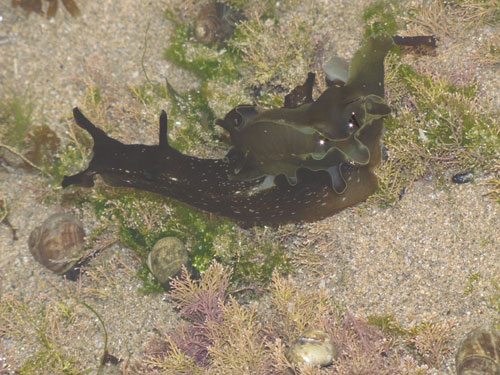
The sea hare is a marine snail, found in shallow water and occasionally in rockpools on the low shore. They feed on seaweed and it is thought that this is what gives each sea hare its colour, e.g. green sea hares are eating green seaweeds like sea lettuce whilst the reddish-maroon sea hares are eating red seaweeds. Sea hares have an internal shell, which is around 4cm long and transparent. Like sea slugs, the sea hare is a hermaphrodite and they sometimes mate in chains, with an individual acting as both male and female. They lay eggs in long pink threads, which are deposited on seaweed and look a bit like pink spaghetti.