All crustaceans are Arthopods, a very large group (phylum) of animals which includes insects, crabs, scorpions, spiders and millipedes.
Arthropods are the largest group of animals on the planet.
Crustacea: Crabs, Prawns, Shrimp etc
Shore Crab: Carcinus maenas

The shore crab is the most common crab encountered on our shores. Normally a green-ish colour, shore crabs are easily found in rockpools or on the end of crab lines dangled into shallow waters.
Also known as the Green Shore Crab.
Edible Crab: Cancer pagurus
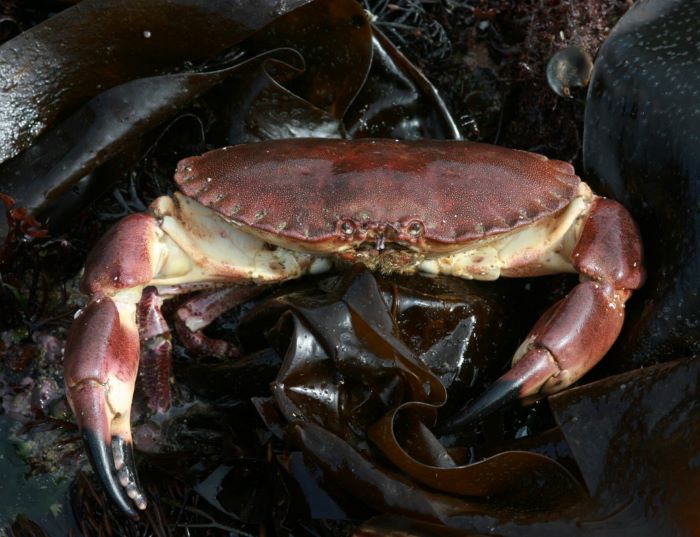
The edible crab is a large crab, brown in colour apart from black tips on the end of its claws. It is sometimes known as the brown crab. They have a thick, oval shaped shell (carapace) with a distinctive pie crust edge. Small juvenile individuals may be found in the rock pools.
They live on the lower shore and out under the sea to about 100m depth. On rocky shores, they are normally hidden away under boulders. It is an active predator and will feast on mussels, whelks and even smaller crabs. They are also known to dig for prey such as razor clams and otter shells.
Velvet Swimming Crab: Necora puber

Their body is covered in short hairs that give a velvet appearance and are soft to the touch, just like velvet. Like all swimming crabs, their rear-most legs are flattened like paddles, helping them swim effectively. They are speedy underwater and will catch swimming prey like fish and prawns, as well as munching on easier catches like worms, clams and sea snails.
If you spot a crab with a big orange mass on their underside, don’t worry – those are their eggs! Females carry the fertilised eggs around with them, protecting the eggs from hungry predators. An egg-carrying female is referred to as “berried”.
Spider Crab: Hyas araneus
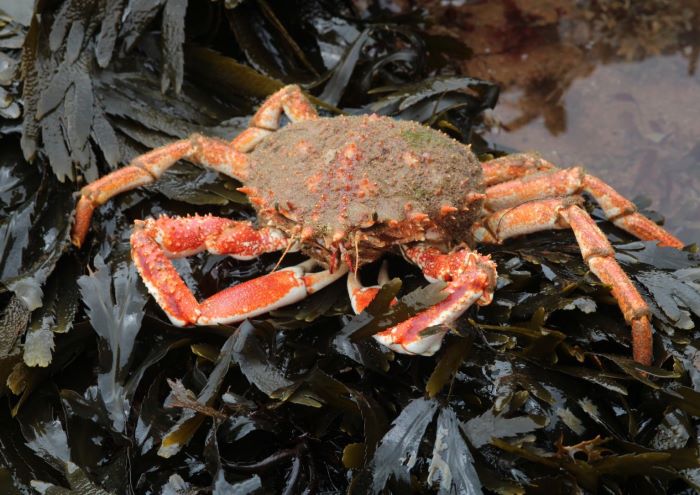
A pear-shaped crab with a pointed face, the great spider crab has long, spindly legs like a spider. Also known as the sea toad, it lives amongst rocks and seaweed from the low tide mark and out to around 50m deep. It is a Northern species, with the UK sitting at the southernmost limit of its range. It is known to be partial to munching on jellyfish.
Spider crabs are very different to ‘typical’ crabs. Orangey brown in colour, the great spider crab has long spindly legs like a spider and a distinctive pear-shaped shell. It is smaller than the spiny spider crab, which has an oval and more visibly spiky shell.
Hermit Crab: Pagurus bernhardus
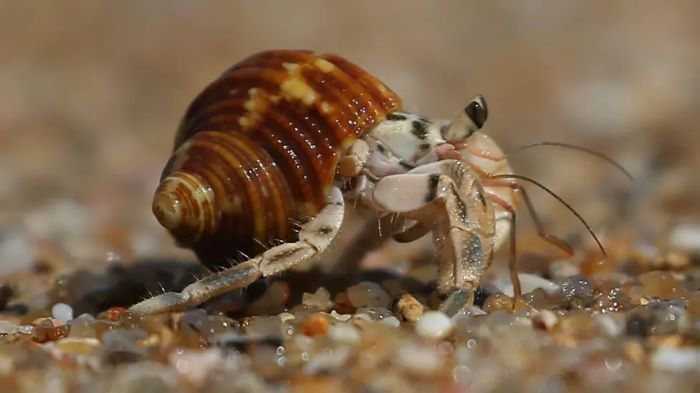
The hermit crab will crawl around with the shell on its back and will only leave when it grows too big, and has to find a new, larger shell, such as that of the common whelk. In most cases, they will use the shells of dead snails, but squabbles for possession of an already occupied shell frequently occur. In addition to finding a new ‘home’, hermit crabs also moult. When ready to moult, the new skeleton grows under the old one. The old exo-skeleton splits and comes off; the new skeleton takes some time to harden.
One of the most fascinating aspects of hermit crab behaviour is their association with other animals. Acorn barnacles, or algae can be found growing on their shells and they can enjoy symbiotic (mutually beneficial) relationships with sea anemones. The anemones’ stinging tentacles help to deter predators and provide amazing camouflage. In return, the sea anemone gets scraps from the Hermit Crab’s meals and is transported to food sources. Some hermit crabs even transfer their anemones when they ‘move’ from a smaller shell into a larger shell. Like all British crab species the hermit crab is a scavenger and will look for dead and dying forms of marine life to feed on.
Squat Lobster: Galathea squamifera
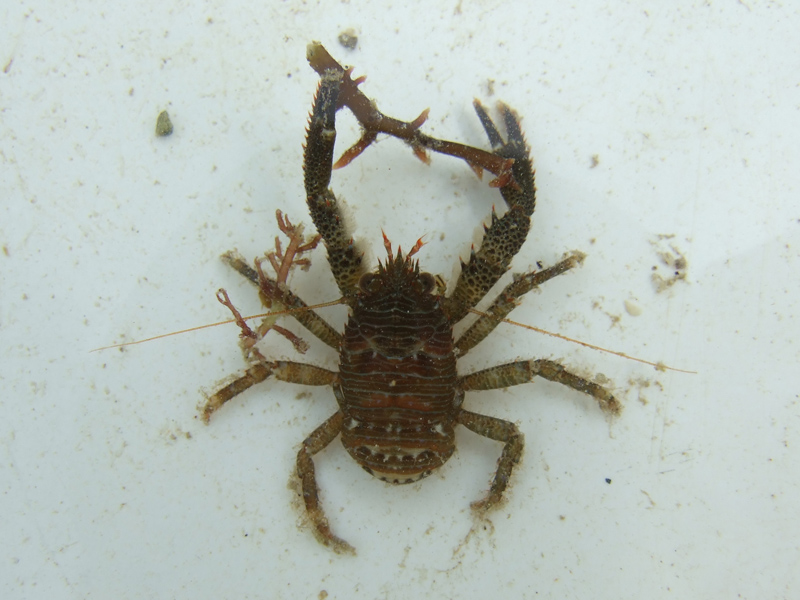
Despite their name, squat lobsters are actually small crabs belonging to the Galatheidae family. They are more closely related to porcelain and hermit crabs than true lobsters.
Common Prawn: Palaemon serratus and Rockpool Shrimp: Palaemon elegans

Common prawns are found in rockpools and shallow waters down to around 40m deep, normally hiding in crevices or under stones. It is virtually identical to the Rockpool Shrimp (Palaemon elegans); they can be told apart by the number of teeth on the rostrum.Common prawns are scavengers and will eat anything they find, from decaying seaweed to dead mussels.
Both have a translucent body with brownish-red tiger stripes along the length. It has large eyes separated by a serrated rostrum. Its walking legs are banded with reddish-brown and bright yellow and it has very long brown antennae.
Sand Hopper: Talitrus saltator
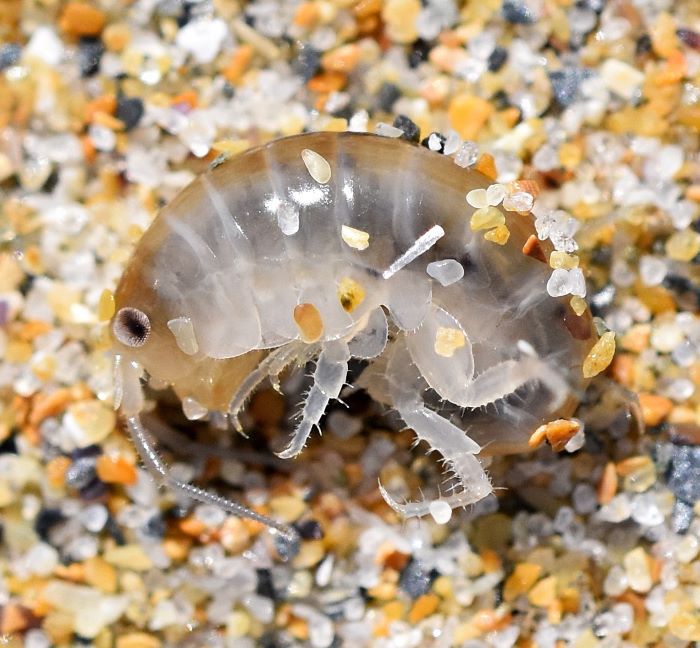
Sand hoppers are pretty small and spend the daytime buried in the sand at depths of 10-30cm or hidden in strandline debris. They emerge at night to feed on decaying seaweed and other detritus. Adults spend the winter in a dormant state, buried in the damp sand at depths of up to 50 cm above the spring tide mark. You will see lots of the hopping around as you turnover beached seaweed.
They are an important food source for shore birds. Sand hoppers are sometimes referred to as sand fleas. This refers only to their jumping abilities – don’t confuse them with the bitey sand fly, sand hoppers don’t bite people.
Barnacles
Barnacles are marine crustaceans, related to crabs and shrimp, characterized by their hard, protective shell and their ability to attach themselves to hard surfaces. They are filter feeders, using feathery appendages called cirri to capture food from the water. Barnacles are also known for their strong, glue-like cement that they use to attach to rocks, ships, and even whales. Two species are illustrated which may well be found on Milsey Bay.
Acorn Barnacle: Semibalanus balanoides
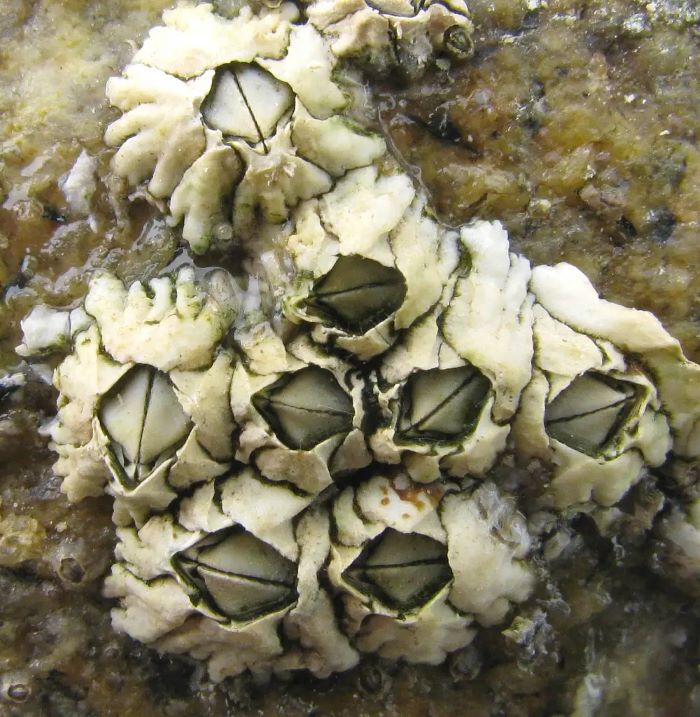
Acorn barnacles are very common in Milsey Bay rock pools. You will find some on most rocks. The Acorn Barnacle: Semibalanus balanoides is a filter feeder, using thoracic appendages, or cirri, to capture zooplankton and detritus from the water. If there is a current, then the barnacle holds its cirri stiffly into the flow, but when there is no current, the barnacle beats its cirri rhythmically.
Although they have no eyes, barnacles are aware of changes in light, and withdraw into their shells when threatened.
You can find clusters of these hard, white, cone-like houses on rocks, dock pilings, boats, and even on mussels and sometimes whales.
Goose Barnacles: Lepas anatifera
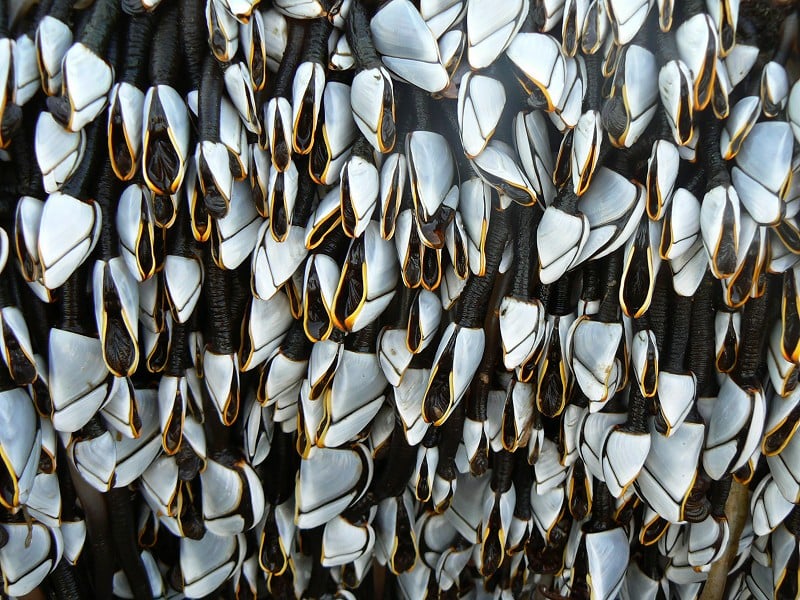
You will be more likely to see a colony of Goose Barnacles washed up on the shore at Milsey Bay rather than in the rock pools.Goose barnacles live attached to rocks, ships, ropes or flotsam floating out at sea. They’ve even been spotted on a chunk of spaceship that washed up in the Isles of Scilly! They are also known as a gooseneck barnacle and have a long fleshy stem that looks like a black neck. The stem or peduncle is topped with a chalky white shell that houses the main body of the barnacle.
Barnacles are a type of crustacean, related to crabs and lobsters. Goose barnacles filter feed on plankton and detritus, capturing it from the water with their specially adapted legs. In many places in the world they are a delicacy – in fact, in days gone by, any ships arriving in Cornwall with goose barnacles on the hull were a real moneyspinner. The goose barnacles would be scraped from the hull and sold for food.
It was once thought that barnacle geese hatched out of goose barnacles attached to ships at sea – their shells washing up on the west coast of Scotland in the autumn. This belief grew because goose barnacles have black-and-white stripes (like the geese) and the nests of barnacle geese were never seen.