Vertebrata:
Vertebrates include mammals, reptiles, amphibians but only fish will be found in the rock pools.
Blennies and Gobies
If you catch or see a fish in a rock pool on Milsey Bay it will probably be either a Goby or a Blenny but it can be hard to tell them apart. One of the easiest ways to identify them is to look at their dorsal fins – if there are two – that’s a Goby, but one long one is a Blenny. Another way to tell the difference is when lying on the bottom of a rock pool, a Goby will have a straight body, whereas a Blenny is curved.
Blenny
Several species of Blennies are found in Scotland, including the common Blenny (sometimes called Shanny), the tompot blenny, and the butterfly blenny. They are all similar in appearance so probably best not to try to identify individuals unless you are an enthusiast.

Elongated body with a large, blunt head and big eyes. Variable in color, often brown or beige with darker blotches. Males are almost black during the breeding season.
Found in rock pools and shallow waters, often hiding under stones or seaweed.
Eats a variety of food, including seaweed, barnacles, and small invertebrates
Goby
There are 16 species of Goby in the UK.
Common Goby: Pomatoschistus microps

Common Gobies are small fish with a sandy grey colouration and darker patches blotching their back and sides. Their eyes are large and sit high up on their heads. This is the one you are most likely to catch or see.
The Common Goby is a small goby growing up to 6 cm in length. The top of the head, nape and throat are scaleless. It is grey or sandy in colour, often with darker blotches across the back and faint marks along the side of the body. There is also a dark area at the base of the pectoral fins and tail fin.
Worm Pipefish: Nerophis lumbriciformis

The Worm Pipefish (Nerophis lumbriciformis) is the most common pipefish found on UK shores. They are long, slender fish that looks like a worm or a piece of seaweed. They can get to 15cm in length, have a small dorsal fin behind the head and are dark green in colour. If you look closely at their head, you’ll notice a small snout similar to a seahorse.
Butterfish: Pholis gunnellus
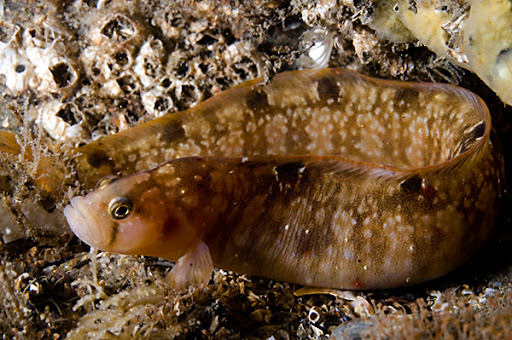
The butterfish is a small eel-like fish found in rockpools and shallow seas all around the UK. They are pretty shy and are normally hidden in crevices or under rocks and seaweed. You might also hear of butterfish being called Gunnels or Rock Gunnels. They feed on anything they can find, including small crustaceans, molluscs and fish eggs. Butterfish lay their eggs on rocky shores, hiding them away from predators in crevices. Unlike in most fish species, both the Mum and the Dad take it in turn to guard their unhatched eggs from hungry predators.
Long Spined Sea Scorpion:Taurulus bubalis

Long spined sea scorpion has a large, bulbous head with a distinctive small barbel in each corner of the mouth. The body tapers down towards the tail, with large pectoral fins which sit behind the head. Colouration is usually mottled with pink, red and sandy blotches. This this species can adapt and blend in perfectly with the surrounding algae and encrusting organisms. Grows up to 20cm.
This colourful fish gets its name from the long spines attached to various parts of its body. This fish has amazing mottled colouration and can change its colouration to blend in perfectly with its background. A top predator it gulps up crabs and fish with its huge mouth.
A guide to identify the fish commonly found in UK rock pools can be found on the link below
C